
Guides
How to Send a Letter Overseas from Australia (2026 Guide)
Sending a letter or document overseas from Australia? Compare Australia Post, couriers, and online services with current 2026 prices and delivery times.
You’ve got something that needs to leave the country. A signed contract heading to a lawyer in London. A birthday card for your nan in Auckland. A tax document the ATO wants posted to an accountant overseas, for reasons known only to the ATO.
Your first instinct is probably the post office. That works — but it’s not your only option, and depending on what you’re sending and how fast it needs to land, it might not even be the best one.
Here’s what sending mail overseas from Australia actually looks like in 2026 — what it costs, how long it takes, and how to figure out which service fits without spending an hour on the Australia Post website.
Your three real options
When something physical needs to get from Point A in Australia to Point B somewhere overseas, you’ve got three legitimate paths.
The DIY route via Australia Post. Print, envelope, queue, hand it over. Australia Post offers four international tiers — Economy Air, Standard, Express, and Courier — running on the same network, with different speeds and price points. This is the default option, and for a one-off letter where time isn’t critical, it’s hard to beat for cost.
A private courier like DHL or FedEx. For high-value or extremely time-sensitive items — original signed documents, anything that genuinely cannot be replaced — couriers are faster and more accountable than postal services. They cost real money. Often $80 to $200 or more for a single envelope. But for the right scenario, that’s cheap.
A digital print-and-mail service. Upload a PDF, someone else handles the printing, envelope, postage, and post office trip. Services like PostMyDoc do this for letters and documents — same Australia Post infrastructure on the back end, but you skip every step in front of it. Useful if you don’t own a printer, your time is worth more than the saving, or you can’t be bothered with the round trip.
The right choice depends on what you’re sending, how fast it needs to arrive, and what an hour of your time is worth. We’ll come back to that with an actual decision framework.
Australia Post’s international services, decoded
Australia Post groups every overseas destination into one of five zones, then charges a flat rate per zone for each service tier. Same envelope, same weight — but the price changes by destination.
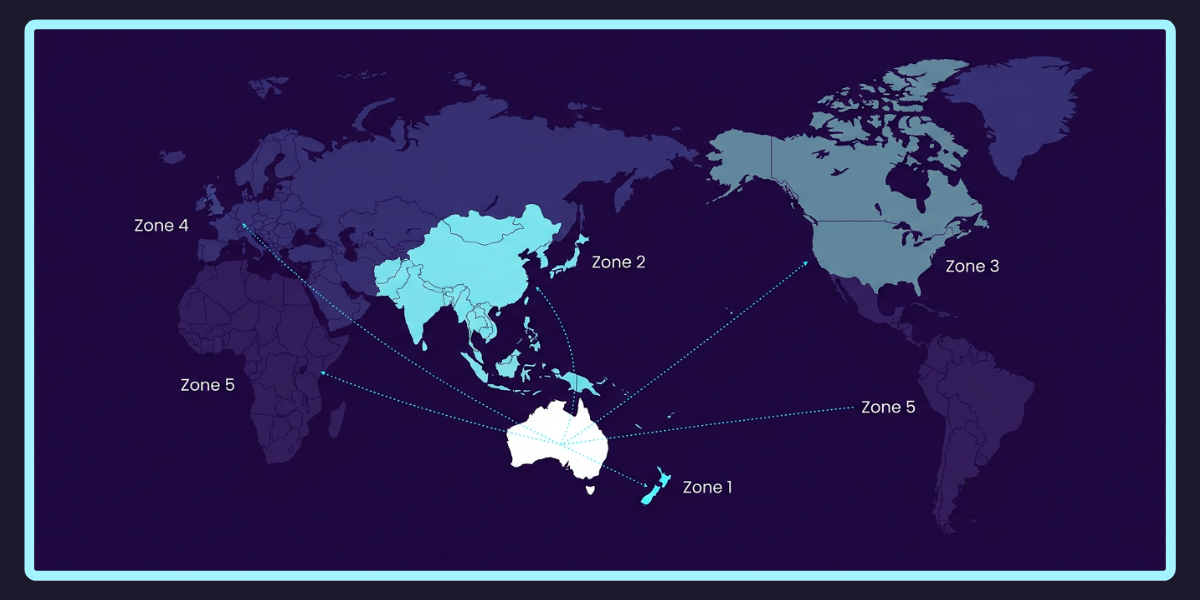
Zone 1: New Zealand
Zone 2: Asia Pacific (Japan, China, Singapore, Indonesia, Malaysia, Thailand, Philippines, South Korea, India, Vietnam, and most of Asia)
Zone 3: USA and Canada
Zone 4: UK and Europe (with a handful of outliers like Russia and South Africa, which Australia Post groups here for rate purposes)
Zone 5: Rest of World — Middle East, Africa, South America, Central America, the Caribbean
You don’t pick the zone. The destination country picks it for you.
The four service tiers
Economy Air is the cheapest international tier. No tracking. Designed for non-urgent mail. Letters up to 50g start from $3.00. Delivery takes 15+ business days. There’s a catch worth flagging: Economy Air letters can only contain printed material with no commercial value. Personal letters, documents, cards — all fine. Anything you’d describe as “merchandise” or “goods” needs a parcel service.
International Standard adds basic tracking. Letters from around $15.90. Roughly 10–15 business days to most destinations.
International Express is the premium tier. Full tracking, faster handling. Letters from around $28.05. Major destinations: usually 5–10 business days.
International Courier is Australia Post’s fastest service, equivalent to a private courier. Same-day pickup options, premium pricing. If you’ve got the budget for it, it’s the closest thing to certainty Australia Post offers.
A note on those numbers: Australia Post updates its international rates roughly once a year, usually around 1 July. Prices above are current as of mid-2025. For the live price for your specific item and destination, the Australia Post postage calculator is the source of truth.
What you can and can’t send as a letter
This trips a lot of people up. Australia Post’s international “letter” services — Economy Air especially — are restricted to printed material with no commercial value. In plain English:
You can send personal letters, business documents, contracts, statements, greeting cards, postcards.
You cannot send cash, cheques, vouchers, gift cards, or anything you’d describe as merchandise. If your item has declared commercial value, you need a parcel service. Different prices, mandatory customs declaration, more paperwork.
If in doubt, ask at the post office before you stick a stamp on it. Getting it wrong means it comes back, gets stuck in customs, or gets opened.
How long it actually takes
Here’s a rough reality check on timeframes. These are Australia Post’s own estimates between major metro areas, not corner-case rural delivery.
| Service | NZ (Zone 1) | Asia Pacific (Z2) | USA/Canada (Z3) | UK/Europe (Z4) | Rest of World (Z5) |
|---|---|---|---|---|---|
| Economy Air | 15+ days | 15+ days | 15+ days | 15+ days | 15+ days |
| International Standard | 10–15 days | 10–15 days | 10–15 days | 10–15 days | 10–15 days |
| International Express | 3–6 days | 3–6 days | 3–6 days | 3–6 days | 3–6 days |
| International Courier | 2–4 days | 2–4 days | 2–4 days | 2–4 days | 2–4 days |
Plus customs. Major destinations are usually fine — letters and documents clear quickly. Stricter destinations (parts of the Middle East and Africa especially) can add a week or more in customs, regardless of how fast Australia Post got it there.
If a deadline is involved, build in slack. Even Express can get stuck.
What it actually costs (the honest version)
The stamp price is one number. The real cost is the whole process.
If you’ve already got a printer, envelopes, and stamps in the drawer, sending a personal letter overseas is genuinely cheap — three bucks gets a small Economy Air letter to most of the world. Hard to beat.
If you don’t, the maths shifts.
For frequent senders — small businesses, solicitors, anyone who finds themselves at the post office more than monthly — that hour adds up fast.
(For a deeper breakdown of the real cost of posting domestically, we did the maths in this post.)
Step-by-step: posting overseas via Australia Post
If you’re going the traditional route, this is the whole process.
1. Print and prepare your document. Single-sided, A4, unless you’ve got a reason otherwise. Don’t fold a contract — flat in a C4 envelope is safer. Important documents deserve a flat envelope, not a creased one.
2. Address the envelope. Recipient’s name, street address, city, state or region, postcode, then the country in capitals on its own line at the bottom. Your return address goes top-left. The country must be on the bottom line in capitals — it’s how the sorting facility knows it’s international. Get this wrong and your letter wanders.
3. Weigh it. A small letter is up to 250g and 5mm thick. Anything larger or heavier bumps to large letter rates, or out of the letter category entirely and into parcels. Kitchen scales work fine if you don’t have postage scales.
4. Pick your service. Economy Air for cheap and slow. Standard for tracking. Express for speed. Courier if it has to be there yesterday.
5. Customs declaration if required. International Express, Standard, and any parcel service require a customs declaration. Economy Air letters typically don’t, as long as you’re sending printed material only. You can fill out the customs form online before you go, which saves time at the counter.
6. Lodge it. International items go through a post office or a street box (street box only for prepaid Economy Air small letters). Anything tracked needs the counter.
That’s the whole DIY process. Maybe 90 minutes door-to-door if the post office isn’t busy, longer if it is.
When each option actually makes sense
A decision framework, minus the marketing fluff.

Australia Post DIY is right when:
- You’ve already got a printer, envelopes, and stamps
- You’re sending one or two letters a year, not weekly
- The post office isn’t a hassle for you
- It’s a personal letter or card, and timing isn’t critical
A courier is right when:
- The document is irreplaceable or genuinely high-value
- It absolutely has to land in 1–3 days
- You need pickup from your address
- The cost is justified by what’s being sent (a $150 courier fee is cheap insurance on a contract worth thousands)
A digital print-and-mail service is right when:
- You don’t own a printer
- You don’t want to queue at the post office
- You want it dispatched the same business day without leaving your kitchen
- Your time is worth more than the price difference
There’s no wrong answer. There’s just the option that fits the situation you’re actually in.
Frequently asked questions
Can I track an Economy Air letter?
No. Economy Air letters have no tracking — that’s part of why they’re cheap. If tracking matters, you need International Standard or above.
Do I need a return address on international mail?
Strictly, no. Practically, yes. If your letter can’t be delivered, it gets returned to the sender. Without a return address, it doesn’t come back — it’s gone. Always include one.
What about customs forms?
Economy Air letters containing only printed material with no commercial value don’t need a customs form. Standard, Express, Courier, and any parcel service do. The form takes about five minutes and can be done online beforehand.
Can I send important documents through Economy Air?
You can. There’s no tracking, no insurance, and 15+ business days of uncertainty in transit. For anything you actually care about, step up to Standard or Express. The price difference is worth the peace of mind.
What’s the cheapest way to send a letter overseas from Australia?
Economy Air, if it fits the size and weight limits and contains only printed material. From $3.00 to New Zealand, slightly more for further zones.
Will my letter get opened by customs?
Maybe. Customs in any country can open international mail at their discretion, especially anything that looks irregular. Letters containing only printed material rarely get opened. Anything that feels like it might contain goods is fair game.
Can I send original documents, or should I send certified copies?
That’s a question for whoever’s receiving it. Some processes require originals (legal documents, statutory declarations). Others accept certified copies, which are easier to replace if the post goes wrong. If originals are required, use a tracked service. Always.