
Guides
How to Get a Letter to Australia Quickly from Overseas (2026 Guide)
Sending a letter to Australia from overseas? Here’s what each option realistically delivers — stamps and envelopes, tracked, couriers — with honest timelines.
If you’re reading this from outside Australia and you need to get a letter or document to someone here, the question isn’t whether it can be done — it’s how to do it fast, cheap, and without it disappearing into the back of a customs queue for three months.
That last part isn’t an exaggeration. Australia is geographically further from most of the world than people realise, and untracked international mail to Australia routinely takes far longer than the advertised timelines suggest. Here’s how international mail to Australia actually works in 2026, what your options realistically deliver from wherever you’re sending, and the shortcut most people don’t know about.
How international mail to Australia works
A quick orientation, because the mechanics matter for understanding the trade-offs.
Australia is geographically far from most of the world. Mail from the UK, Europe, or North America has to cross roughly half the planet to get here. Even a premium tracked service takes at least 5–10 business days from those origins. From New Zealand and Southeast Asia, much less.
Once mail arrives in Australia, it goes through Australian customs — which for ordinary letters and documents is almost always fast and frictionless, but can occasionally add 1–3 days. From there, it enters the Australia Post domestic network and gets delivered like any local letter.
The journey has three phases: leaving your country, the international transit, and the Australia Post domestic leg. Speeding up the whole journey usually means optimising the first two — the third is the same regardless of how it got into the country.
The honest truth about untracked international mail to Australia
Worth getting out of the way upfront, because the advertised timelines lie.
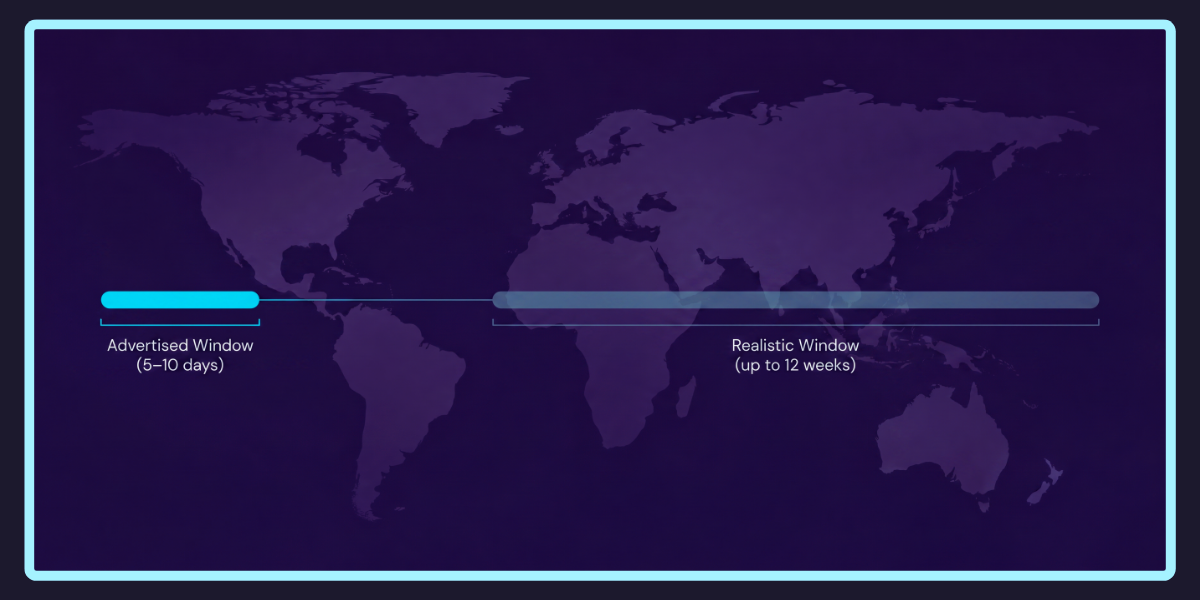
Every national postal service publishes optimistic delivery aims for standard untracked international mail to Australia. Royal Mail’s International Standard aims for 6–7 working days from the UK. USPS doesn’t actually publish a specific aim for First-Class Mail International to Australia — they explicitly state they don’t guarantee delivery dates — but third-party industry sources put it in the 10–21 business day range. India Post quotes 7–14 working days. Most European postal services quote 7–14. These numbers are technically achievable — for the fastest items, under ideal conditions, with no customs scrutiny and no operational hiccups.
The real-world average is longer. The real-world tail — the slowest 10–15% of items — can stretch to 6, 8, or in occasional cases up to 12 weeks. Untracked international mail to Australia has no transparency into where the item is at any point in transit. Lost items are common enough that postal services don’t generally consider an item officially lost until at least 25 working days have passed.
If you’re sending something where late-is-fine, untracked mail is genuinely the cheapest option and usually works. If you’re sending something where late-is-a-problem, don’t use untracked. The savings of a few dollars per letter against the risk of a multi-week disappearance is not a sensible trade.
The premium tracked services hit their advertised windows far more reliably because the tracking infrastructure provides accountability that untracked mail simply doesn’t have.
Your options, depending on where you’re sending from
From the UK
Royal Mail International Standard (untracked, stamps and envelope): the standard untracked option. Around £2–£4 for a standard letter. Royal Mail’s own advertised aim: 6–7 working days worldwide. Realistic timeline: 10 days to 12 weeks, with most items arriving within 3–7 weeks. Suitable only for non-urgent correspondence.
Royal Mail International Economy: an even cheaper option for non-urgent items. The advertised aim is up to 84 days (12 weeks) — Royal Mail is upfront that this is the slow service. Worth knowing it exists, but the cost savings versus International Standard are usually small and the time difference is not.
Royal Mail International Tracked & Signed: tracked the entire journey, signature on delivery in Australia. Typical delivery: 5–7 working days, usually reliably. Cost: roughly £10–£15 for a letter.
Couriers (DHL, FedEx, UPS): door-to-door pickup, full tracking, fastest option. Typical delivery: 2–4 business days. Cost: usually £50–£100 for a document envelope.
From the USA
USPS First-Class Mail International (untracked, stamps and envelope): cheapest option. Around $1.65–$5 for a standard letter depending on weight. USPS does not publish a specific advertised delivery time for FCMI to Australia and explicitly states they don’t guarantee delivery dates; third-party industry estimates put the typical range at 10–21 business days. Realistic timeline: 2–6 weeks, occasionally longer. Suitable only for genuinely non-urgent items.
USPS Priority Mail International: USPS’s standard tracked service. 6–10 business days to Australia. Around $40–$60 for a small flat-rate envelope.
USPS Priority Mail Express International: premium tier. 3–5 business days typically. $70–$100+.
Couriers (FedEx, UPS, DHL): door-to-door, 2–4 business days, $60–$150 for a document.
From Canada
Canada Post International Letter-Post (untracked, stamps and envelope): cheapest option. Around CAD $2.80–$5 for a standard letter. Realistic timeline 3–6 weeks, occasionally longer.
Canada Post Xpresspost International: tracked international service. 6–10 business days. Around CAD $50–$70 for a document.
Couriers: 2–4 business days, CAD $70–$140.
From New Zealand
The fastest origin country by a wide margin, because the geography is in your favour.
NZ Post International Economy (untracked): around NZD $4–$6 for a standard letter. Realistic 3–6 business days, sometimes longer. Untracked mail from NZ to Australia is unusually fast and reliable by international standards.
NZ Post International Tracked: around NZD $11–$15. 2–4 business days, usually reliable.
Couriers: rarely necessary for NZ-to-Australia mail given how fast standard tracked already is.
From India
A major origin for mail to Australia, particularly for documents related to immigration, education, family, and business.
India Post International Ordinary Letter Post (untracked, stamps and envelope): the cheapest option. Around ₹50–₹150 for a standard letter depending on weight. Advertised 7–14 working days. Realistic timeline: 3–6 weeks, with the slowest items occasionally taking longer. Suitable for non-urgent correspondence only.
India Post International Registered Letter: untracked but with registration, providing limited proof of dispatch. Around ₹200–₹400 for a standard letter. Marginally better reliability than ordinary post but similar timeline.
India Post EMS (Speed Post International): tracked international service. Around ₹1,500–₹2,500 for a standard document (priced in 250g slabs). Typical delivery: 7–14 working days, usually reliably.
Couriers (DHL, FedEx, Aramex from India): 3–5 business days, around ₹3,000–₹6,000 for a document envelope.
Important practical note: book international mail at a Head Post Office rather than a branch where possible. Branch offices typically route international mail via the district HO, adding 1–2 days.
From Germany, France, and Western Europe
Standard untracked international letter (Deutsche Post, La Poste, PostNL, Posten, etc.): around €1.10–€2.50 for a standard letter depending on origin. Advertised 7–14 working days. Realistic timeline: 2–5 weeks, with occasional outliers up to 8 weeks.
Tracked international services (Deutsche Post International, Colissimo International, etc.): around €15–€30 for a tracked letter. Typical delivery 5–10 business days, usually reliably.
Couriers (DHL, DPD, UPS, FedEx): door-to-door, 2–4 business days, €40–€100 for a document envelope.
From Singapore, Malaysia, Thailand, Japan, China and East Asia
Geographically the closest origin region to Australia after New Zealand, so transit times are usefully shorter.
Standard untracked international letter (SingPost, Pos Malaysia, Japan Post International, China Post International): around SGD $1.50–$3.50 / MYR 5–10 / ¥130–¥300 / RMB 7–15 for a standard letter. Advertised 5–10 working days. Realistic timeline: 1–3 weeks for most items, occasionally longer. The geographic proximity helps — even untracked mail from East Asia to Australia is meaningfully faster than from Europe or North America.
Tracked international services: around SGD $15–$25 / equivalent in local currency. Typical delivery 4–8 business days.
Couriers: 2–3 business days, often the most cost-effective premium option from this region.
From the Philippines
PhilPost International Airmail Letter (untracked): around PHP 60–150 for a standard letter. Advertised 7–14 working days. Realistic timeline: 2–6 weeks, with significant variability. PhilPost’s international service is functional but slower than most peers.
PhilPost International Registered Letter: marginally more reliable, around PHP 200–400.
LBC Express International / 2GO International: the most-used premium options from the Philippines. 3–7 business days, PHP 800–2,000 for a document envelope. More reliable than postal services for time-sensitive items.
Couriers (DHL, FedEx, UPS): 2–4 business days, PHP 2,500–6,000.
From the UAE, Saudi Arabia, and the Middle East
Emirates Post / Saudi Post International (untracked): around AED 5–15 / SAR 15–30 for a standard letter. Advertised 7–14 working days. Realistic timeline: 2–4 weeks, sometimes longer.
Tracked international services: AED 30–60 / SAR 60–120, 5–10 business days typically.
Couriers (DHL, Aramex): 2–4 business days, AED 80–200 / SAR 150–400. Aramex is particularly strong from this region.
From elsewhere in the world
If you’re sending from a country not listed above, the pattern is consistent regardless of origin:
Standard untracked international letter via your national postal service: usually $1–$5 USD equivalent for a basic letter. Advertised timelines of 7–14 working days are essentially universal; realistic timelines run 2–8 weeks depending on origin and the efficiency of the local postal service. Use only for non-urgent correspondence.
Tracked international services: typically $20–$50 USD equivalent. Advertised 5–10 business day delivery, usually reliable.
Couriers (DHL, FedEx, UPS) from anywhere: 2–5 business days, $60–$200 for a document envelope. The price varies more by origin distance than by service tier.
What it actually costs to send to Australia
The pattern is consistent across origins: standard untracked mail is cheap but slow with significant tail risk. Tracked services cost roughly 5–10× untracked but deliver in their advertised windows reliably. Couriers cost 10–30× untracked but deliver in 2–4 days from anywhere.
The cost-versus-speed trade-off is steeper for international mail to Australia than for shorter international routes because the geographic distance is greater. Doubling the price doesn’t double the speed — but for time-sensitive documents, the premium tiers genuinely deliver faster and more predictably.
The shortcut most people don’t know about
Here’s the thing about getting a letter to Australia from overseas: you don’t actually have to send it from overseas.
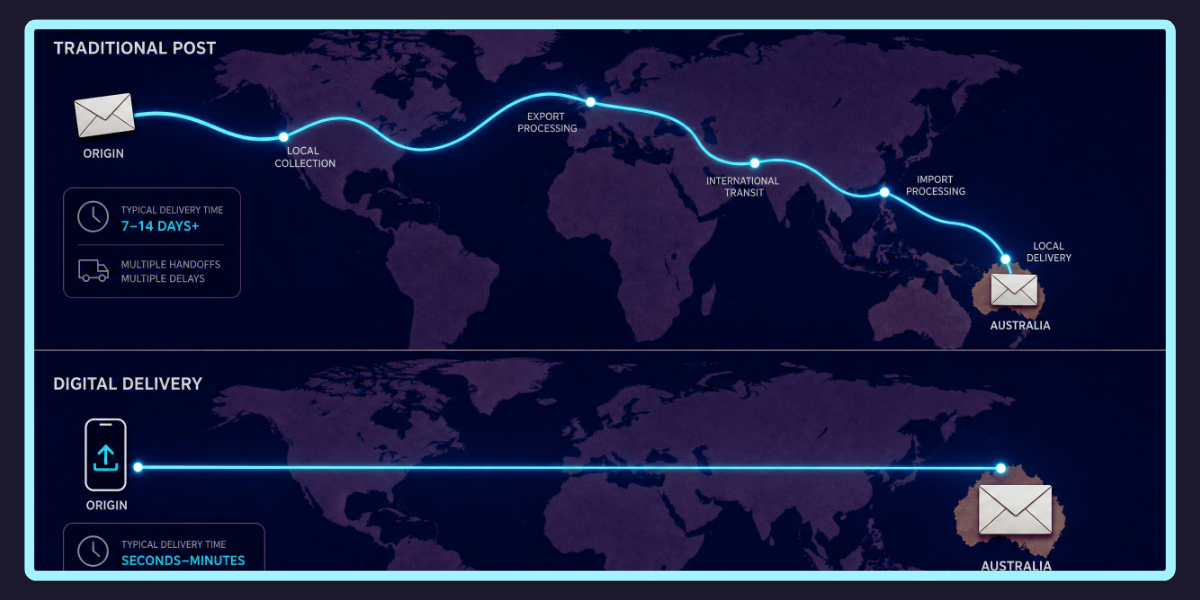
If you have the document as a PDF — and most documents either start as PDFs or can be turned into them in two minutes — you can have an Australian print-and-mail service handle the entire physical journey inside Australia, while you handle the digital upload from wherever you are. The document never crosses an international border physically. It crosses digitally, gets printed in Australia, and enters the Australian postal network as a domestic letter.
The implications:
Delivery time drops to 1–4 business days instead of weeks. Once the letter is in the Australia Post domestic network, standard delivery is 1–4 business days nationally, Express Post is next-business-day to most addresses.
Cost drops significantly. Domestic Australian letter postage is around $1.70 for a small letter; print-and-mail services charge a service fee on top. Total cost is typically $4–$10 for a standard letter or $11–$15 for Express — far less than international postage from most origin countries, and dramatically cheaper than couriers.
You skip customs entirely. No customs declarations, no inspection delays, no risk of items being held at the border.
You skip the trip to your local post office. You upload a PDF from your phone or computer.
You skip the untracked-mail tail risk entirely. Domestic Australian mail is tracked end-to-end on most services, and the worst-case timeline is measured in days, not weeks.
This is what PostMyDoc is built for. For UK, US, Canadian, NZ, and Indian senders specifically, PostMyDoc has country-specific pages with pricing in your local currency so you don’t need to convert AUD in your head.
When the digital shortcut isn’t right for you
It works for most documents, but not all.
Originals required: if the recipient needs a physical original with a wet signature, the shortcut doesn’t apply. You’re sending a printed copy, not the original you signed.
Documents already in physical form only: if you only have a paper copy of the document and can’t easily scan it, you’d need to scan it first — turning it into a PDF — before the shortcut works. (That’s its own how-to, if you need it.)
Recipient expects an international postmark: rare, but some bureaucratic processes specifically require the document to have travelled physically across an international border.
Custom packaging or items that aren’t documents: print-and-mail services handle documents, not parcels. If you’re sending physical items, you need a courier or international post.
For everything else — which is most things — the digital shortcut is faster, cheaper, more reliable, and skips most of the friction.
A practical decision framework
If you have a PDF and the document needs to arrive in 1–4 business days: use an Australian print-and-mail service. Same-day dispatch if you order early enough.
If you have a PDF and the document can arrive in a week: the digital shortcut is still usually the right choice — cost savings are significant and the reliability is dramatically better than untracked international mail.
If you have a physical original that must travel with the recipient: tracked international post for medium-value, courier for high-value. Avoid untracked services for anything important.
If it’s irreplaceable or extremely time-critical: courier, every time. The cost is justified by the assurance.
If you don’t have it in PDF and can’t easily get a scan: tracked international post is the default.
Frequently asked questions
Why does untracked mail to Australia take so long sometimes?
Untracked international mail is processed without individual handling priority. Items can sit in sorting facilities, customs queues, or in-transit hubs for extended periods with no visibility into where they are. The advertised timelines reflect best-case averages, not realistic ones. Australia is also further from most origin countries than other common destinations, which lengthens the baseline transit time.
What’s the cheapest way to send a letter to Australia overall?
A standard untracked stamp-and-envelope letter from your national postal service. Cost-effective only if the document isn’t time-sensitive and you can accept a multi-week realistic timeline.
Is there a faster way than the postal service?
Yes — either couriers (DHL, FedEx, UPS) for door-to-door international service, or a digital print-and-mail service in Australia for the document-only use case.
Does Australia have customs delays for letters?
Letters and documents almost always pass through Australian customs quickly. Parcels are inspected more carefully. For document mail, customs delay is usually minimal — though the slowest items in the untracked pool sometimes spend extended periods in customs without any clear reason.
Can I track a standard untracked letter to Australia?
No. Standard untracked international mail is genuinely untracked — there’s no way to look up where it is in transit, no proof of delivery, and no recourse if it disappears.
Do I need to declare anything for a document going to Australia?
For ordinary documents and personal correspondence, no special declarations beyond the standard customs form (where required by the service). Items with commercial value need a customs declaration with the value specified.