
Guides
How to Send a Letter in Australia: A Complete Guide (2026)
New to sending physical mail, or out of practice? Here’s how to send a letter in Australia — addresses, stamps, envelopes, weight — without overthinking it.
Sending a letter used to be one of those things everybody learned by watching their parents do it. Address the envelope, stick on a stamp, drop it in the red post box on the corner. You didn’t need a guide.
That’s not true anymore. A lot of adults — particularly anyone under thirty-five, anyone who’s spent the last decade in fully digital communication, or anyone who simply hasn’t sent a physical letter in years — has a perfectly reasonable moment of wait, how does this actually work? The instructions used to be common knowledge. Now they’re a niche skill, like changing a tyre or reading a paper map.
Here’s the whole process, from blank envelope to postbox, with all the small details Australia Post quietly assumes you already know.
What you need before you start
You need an envelope, enough stamps, the recipient’s address, and either a printed document or a handwritten letter to put inside it.
If you’re sending a printed document, you’ll need access to a printer. If you’re sending a handwritten letter, you’ll just need paper. Either is fine — physical mail accepts both.
If you don’t have envelopes or stamps at home, Officeworks is the most cost-effective one-stop — you can buy envelopes, stamps, and print your document there in one trip, which is what makes it the practical choice for anyone who needs to print and post in the same outing. Stamps and envelopes are also available at supermarkets like Woolworths and Coles, most newsagents, and some service stations.
For convenience over cost, the post office itself is the alternative one-stop, especially if you don’t need to print anything. Envelopes cost more there than at Officeworks, but the staff can weigh your letter, advise on postage, and lodge it on the spot. Post offices do not offer printing services — if you need to print, that has to happen elsewhere first.
What goes where on the envelope

Three things go on the front of an envelope:
The recipient’s address sits in the centre or lower-centre of the front. This is the address the letter is going to.
Stamps go in the top-right corner of the front. One stamp or several, depending on weight (we’ll get to that).
Your return address (the sender) goes in the top-left corner of the front, or on the back of the envelope. This is the address the letter would come back to if it can’t be delivered. It’s not strictly required, but you absolutely want to include it — without a return address, undeliverable mail is destroyed, not returned.
That’s the whole layout. The address goes in the middle, stamps top-right, your address top-left.
How to write an Australian address
Australia uses a specific address format that differs from US, UK, and most European formats. Get this right and the letter sorts cleanly. Get it wrong and it can be delayed or misrouted.
The format is:
Recipient's Name
Apartment/Unit Number (if applicable)
Street Number and Street Name
SUBURB STATE POSTCODE
A real example:
Sarah Chen
14/45 Bourke Street
SURRY HILLS NSW 2010
Three details people get wrong:
The suburb, state, and postcode go on the same line. Not three separate lines. One line, in that order: suburb first, then state abbreviation, then postcode.
The suburb and state should be in capital letters. Australia Post uses optical character recognition to sort mail, and the sorting machines read capital-letter suburb names more reliably. Lowercase works but slows things down.
State abbreviations are standard: NSW (New South Wales), VIC (Victoria), QLD (Queensland), WA (Western Australia), SA (South Australia), TAS (Tasmania), ACT (Australian Capital Territory), NT (Northern Territory). Always use these abbreviations, always in capitals.
If the apartment or unit number is separate from the street number, write it as unit/street — for example, 14/45 Bourke Street means unit 14 at street number 45. This is universal Australian convention.
For PO Boxes, the format is PO Box 1234 on the line where you’d usually put the street address. No street name needed.
Where to put your own address
Two options, both acceptable:
Top-left front of the envelope. Same format as the recipient’s address, just smaller and tucked into the corner. This is the more visible option and the standard for business mail.
The back of the envelope, on the flap or just below it. Slightly more elegant for personal letters, especially formal correspondence. Same format.
Either works. Just don’t skip it.
Envelopes: which size for what
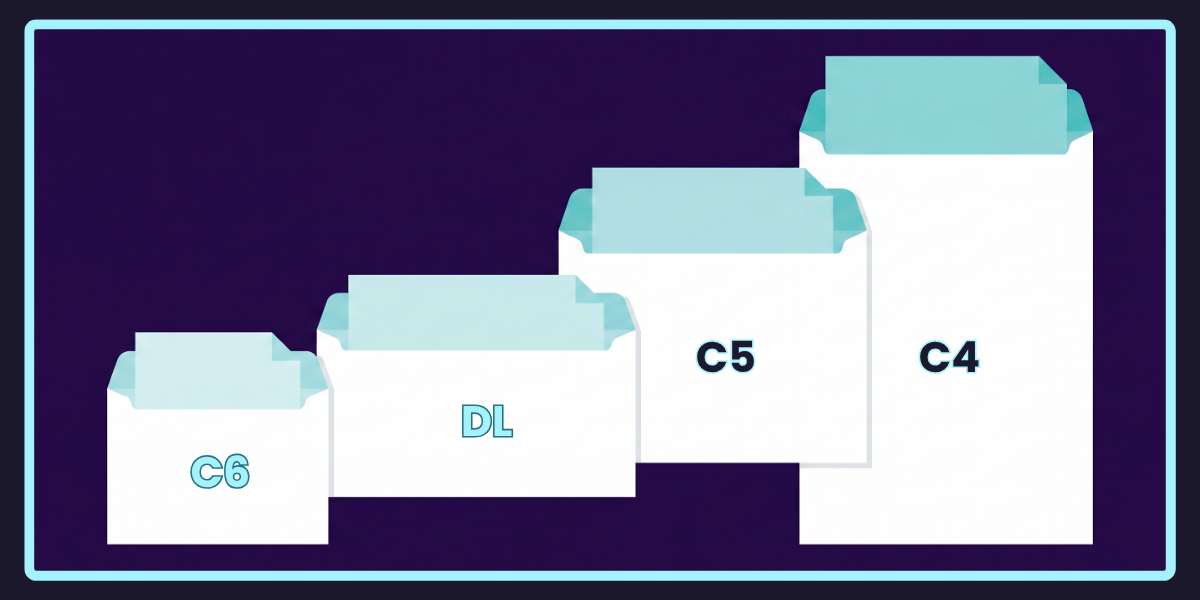
Australia Post categorises envelopes by size, not by name. But envelopes are sold by name (DL, C5, C4, etc.), and the names don’t map cleanly to the categories.
The two Australia Post categories that matter:
Small letter: maximum 130 × 240mm, maximum 5mm thick, maximum 250g. Cheapest postage rate. One stamp ($1.70) covers it.
Large letter: rectangular, maximum 260 × 360mm, maximum 20mm thick, maximum 500g. More expensive. Multiple stamps required, with the number depending on weight.
Now the envelope sizes you’ll actually buy:
DL envelope (110 × 220mm) and DLX envelope (120 × 235mm) — the standard “business envelopes.” Both fit an A4 page folded into thirds. Qualifies as a small letter as long as contents stay within 5mm thick and 250g. In practice: around 8–9 folded A4 sheets is comfortable. Between 10 and 12 sheets, you’re in mindful-of-the-5mm-limit territory — fold the creases carefully and flatten the document before sealing. Beyond 12 sheets is risky; counter staff will sometimes reject thicker envelopes on the spot, and red post box lodgement just means the underpaid-mail bill catches up with you later. DLX gives a touch more room but most people don’t have those at home. One $1.70 stamp within those limits.
C6 envelope (114 × 162mm) — smaller, used for greeting cards and short notes. Fits an A4 page folded twice. Qualifies as a small letter as long as contents stay within 5mm thick and 250g. One $1.70 stamp within those limits.
C5 envelope (162 × 229mm) — fits an A4 page folded in half. Even though a C5 is smaller than C4, its 162mm width exceeds the 130mm small letter limit, which puts it into the large letter category. Two $1.70 stamps minimum. Both the envelope size and the weight matter for pricing — the envelope determines that it’s a large letter (rather than a small letter), and the weight then determines which large letter tier applies (two stamps up to 125g, three up to 250g, five up to 500g). A nearly empty C5 with one folded sheet inside still costs $3.40 because the envelope size alone is enough to put it in the lowest large letter tier.
C4 envelope (229 × 324mm) — fits an unfolded A4 page. Always a large letter (the envelope size puts it there). The specific number of stamps depends on weight: two $1.70 stamps for contents up to 125g (roughly 24 single-sided A4 sheets including envelope), three stamps for 126–250g, five stamps for 251–500g. Most multi-page documents in a C4 land in the two- or three-stamp range.
B4 envelope (250 × 353mm) — slightly larger than C4, with more room. Also always a large letter. Same weight-based stamp scale: two, three, or five $1.70 stamps depending on weight.
The practical implication: if you’re sending an A4 document and you want the cheapest rate, fold it into thirds and use a DL envelope. If you fold it in half and use a C5, you pay double. Folding into thirds is standard professional practice for business letters precisely because it qualifies for the small letter rate.
A consideration that runs the other way, though: some documents shouldn’t be folded at all. Signed contracts, formal letters on letterhead, CVs being couriered to an interview, certificates, anything where the document’s presentation is part of its message — these benefit from arriving flat. The cost saving from folding into thirds is real, but for documents where the fold itself would feel inappropriate, the right call is a C4 or B4 envelope (large letter rate) even though it costs more. Match the envelope to the document’s purpose, not just to the cheapest rate.
Stamps: how many and how much
Australia Post’s current rates (since 17 July 2025):
Small letter: $1.70. One stamp covers it, as long as the envelope stays within all three small letter limits — 130 × 240mm, 5mm thick, 250g. If it exceeds any one of these (most often thickness, before weight), it’s no longer a small letter and the large letter rates below apply.
Large letter up to 125g: $3.40. Two $1.70 stamps.
Large letter, 126–250g: $5.10. Three $1.70 stamps.
Large letter, 251–500g: $8.50. Five $1.70 stamps.
That’s the whole rate card for regular domestic mail. (Australia Post has proposed raising the basic small letter rate to $1.85 in mid-to-late 2026, pending ACCC approval, so these prices will likely shift.)
If you need a letter to arrive faster, Priority adds $1.00 to any of the above rates and aims for delivery 2–4 business days same-state, up to 4 days interstate. To use Priority, place a Priority label next to your stamps.
For genuinely time-sensitive mail, Express Post is the premium tier. Express Post envelopes are prepaid and sold individually — they include the postage in the envelope price. The standard option for most documents is a DL Express Post envelope at $9.00, which holds up to 500g and fits an A4 document folded into thirds. The B4 Express Post envelope at around $11.05 is the right choice when you don’t want the document folded — for signed contracts, formal letters on letterhead, CVs, certificates, or anything where the fold itself would undermine the document’s presentation. B4 also handles larger or thicker items. Both DL and B4 Express Post aim for next-business-day delivery between most metro areas.
How to estimate the weight without weighing it
Most people don’t own postage scales. Fortunately, the weight of a letter is easy to estimate with reasonable accuracy.
Standard 80gsm A4 paper weighs almost exactly 5 grams per sheet. This is the most useful number to know when sending letters. The maths: an A4 sheet is 297 × 210mm, which is 0.0624 square metres. Standard 80gsm paper weighs 80 grams per square metre. Multiply: 4.99 grams per sheet. Round to 5.
A standard DL envelope weighs around 5 grams. Larger envelopes scale up — a C4 envelope is around 10–15 grams.
So a quick mental calculation:
- 1-page letter in a DL envelope: 5 + 5 = ~10g (small letter, $1.70)
- 3-page letter folded into a DL envelope: 15 + 5 = ~20g (small letter, $1.70)
- 8-page document folded into a DL envelope: 40 + 5 = ~45g (small letter, $1.70 — comfortable thickness)
- 10-page document folded into a DL envelope: 50 + 5 = ~55g (still small letter by weight, but at the edge of the 5mm thickness limit — fold and flatten carefully)
- 15-page document in a C4 envelope (won’t fit DL by thickness): 75 + 12 = ~87g (large letter up to 125g rate, $3.40)
- 25-page document in a C4 envelope: 125 + 12 = ~137g (now in 126–250g tier, $5.10)
- 30-page document in a C4 envelope: 150 + 12 = ~162g (same 126–250g tier, $5.10)
A useful trick for heavier documents: print double-sided where possible. A 20-page document printed double-sided becomes 10 physical sheets at ~50g, instead of 20 sheets at ~100g. That can keep you under a pricing threshold and save real money on bulk mail-outs.
The size and weight cliff edges that cost people money
A few specific traps worth knowing:
Thickness over 5mm pushes you from small letter to large letter. This happens faster than you’d think. A few folded pages, or a card with a folded insert, can easily exceed 5mm. If your envelope doesn’t lie flat at letterbox-slot thickness, it’s a large letter — minimum $3.40 (two stamps), regardless of weight. For most small-letter senders, this is the cliff that actually triggers first, because envelope dimensions usually mean you’d hit 5mm thick well before approaching the 250g weight limit.
Within the large letter category, watch the 125g and 250g tier boundaries. A large letter goes from $3.40 to $5.10 once contents exceed 125g — a 50% increase for one extra stamp. From $5.10 to $8.50 once contents exceed 250g — a 67% increase, two more stamps. If you’re close to either threshold, it’s worth weighing more carefully or printing double-sided to stay in the cheaper tier.
Anything over 500g, or thicker than 20mm, or larger than 260 × 360mm, is a parcel. Parcels start at $9.70 — almost 6× the small letter rate. This is the biggest pricing cliff. A 22mm-thick envelope that looks like a thick letter is, by Australia Post’s rules, a parcel. Different stamps, different counter, different rate.
Inflexible items can’t go in a letter envelope at all. Keys, USBs, pens, bottle tops, anything rigid — these can’t be sent in regular paper envelopes because the high-speed letter-sorting machinery can damage them and the rest of the mail in the same batch. If you’re sending anything with rigid bulk, it needs a padded bag and goes as a parcel.
Where to actually post the letter
Once your envelope is addressed, stamped, and sealed, you have two options:
A red Australia Post street box. Found on streetcorners across the country. For regular letters with stamps, just drop it in the slot. The box is collected daily on business days. Small letters and large letters both go here.
A post office. Required for anything tracked (Registered Post, Express Post with signature), anything you want a receipt for, and any parcel. Optional but useful if you’re not sure your letter is correctly stamped — the staff can weigh it and tell you whether you need more postage.
If you’re using a prepaid envelope (Express Post or Registered Post), you can lodge it in a street box or at a post office. Prepaid envelopes don’t need additional stamps because the postage is built into the envelope price.
This guide assumes a red post box or a post office is reasonably reachable from where you are. If you’re rural, remote, or in a part of a city where neither is convenient and you don’t drive, your options change. That’s a different post.
A quick checklist before posting
If you’re sending a letter and want to make sure you haven’t missed anything:
- Recipient’s address written clearly, suburb/state/postcode on one line in capitals
- Sender’s address on the front top-left or on the back of the envelope
- Correct stamps in the top-right corner — one $1.70 stamp for small letters, two or more for large letters depending on weight
- Envelope sealed (lick the gum strip or use a self-seal flap)
- Postage stamps actually stuck on, not just placed loose
Drop it in the box.
Frequently asked questions
Do I need to include the country if I’m posting within Australia?
No. Australian mail doesn’t need the country. If you’re posting to Australia from another country, you need to add AUSTRALIA in capitals on the bottom line.
Can I send cash in a letter?
You can, but you shouldn’t. Australia Post doesn’t insure cash sent in regular mail, and untracked letters offer no recourse if the envelope is lost or interfered with. Use a money order, bank transfer, or PayID for transferring money.
What if I put the wrong stamp value on?
If you underpay, Australia Post will usually deliver the letter anyway and send you an Underpaid Mail invoice for the shortfall plus an administration fee. In some cases they may hold the item until the correct postage is paid, or charge the recipient if they can’t identify the sender from the envelope. This is one reason a return address matters. Overpaying is fine — you’ve just spent more than you needed to.
Does writing in pen vs typing matter?
For the addresses, typed or printed labels are slightly more reliable for the sorting machinery, but handwritten addresses are completely standard and accepted. Just make sure the handwriting is legible, particularly the postcode.
Can I post a letter on a Sunday?
You can put it in a street box on Sunday — it just won’t be collected until Monday. Australia Post collects from street boxes on business days only.
What if the recipient is overseas?
International mail is a different process, with different envelopes, different postage rates by destination zone, and customs declarations for most services. We’ve covered that separately in how to send a letter overseas from Australia.
Are stamps the same as prepaid envelopes?
No. A stamp is postage you stick onto a regular envelope you’ve supplied yourself. A prepaid envelope is sold with the postage already built in — you don’t add stamps. Prepaid envelopes are slightly more expensive than buying the envelope and stamps separately, but they include features like tracking (for Registered Post) or express service (for Express Post).
Do I really need the postcode?
Yes. The postcode is what tells Australia Post’s sorting system where the letter is going. Without it, the letter is sorted manually based on the suburb name, which is slower and more error-prone. Always include the postcode.